

Ethernet cable assemblies are the backbone of modern networking, enabling high-speed data transmission between devices. Below is an overview of key standards, categorized by performance and shielding types.
1. Twisted Pair Cables (UTP/STP/FTP)
Twisted pair cables use pairs of insulated copper wires twisted together to reduce electromagnetic interference. They are classified by categories (Cat) based on performance:
1.1 Unshielded Twisted Pair (UTP)
Features: No shielding layer; lightweight, flexible, and cost-effective.
Common Standards:
Cat5: Supports up to 100 Mbps (100 MHz bandwidth). Used for basic Ethernet networks.
Cat5e (Enhanced): Reduces crosstalk; supports up to 1 Gbps (100 MHz). Widely used in home and office networks.
Cat6: Supports up to 10 Gbps (250 MHz) over short distances (≤55m). Ideal for high-speed applications like gaming and streaming.
Cat6a (Augmented): Fully shielded; supports 10 Gbps over 100m. Used in data centers and enterprise networks.
Cat7: Shielded (STP); supports up to 10 Gbps (600 MHz). Designed for high-frequency environments.
Cat8: Optimized for data centers; supports up to 40 Gbps (2000 MHz) over 30m.
1.2 Shielded Twisted Pair (STP/FTP)
Features: Additional shielding (foil or braided) to reduce interference. Higher cost and complexity.
Common Standards:
Cat6a/7/8: Used in industrial or high-interference environments.
1.3 Plenum Cables (CMP)
Features: Fire-resistant insulation; used in air ducts and plenum spaces.
Common Standards:
Cat5e/6/6a CMP: Meets fire safety standards for buildings.
1.4 Outdoor-Rated Cables (Riser/Outdoor)
Features: UV-resistant and waterproof jackets; used for outdoor installations.
Common Standards:
Cat5e/6/6a Outdoor: Designed for direct burial or aerial use.
1.5 Armored Cables (CATX)
Features: Metal armor for physical protection; used in harsh environments.
Common Standards:
Cat6/6a Armored: Suitable for industrial or military applications.
2. Coaxial Cables (RG6/RG11)
Features: Single copper core with shielding; used for cable TV and internet.
Common Standards:
RG6: Supports up to 1 Gbps; used for digital video and internet.
RG11: Thicker core; supports longer distances (up to 500m).
3. Fiber Optic Cables (Single-Mode/Multi-Mode)
Features: Glass fibers for long-distance and high-speed data transmission.
Common Standards:
Multi-Mode (OM3/OM4): Used for short distances (up to 550m).
Single-Mode (OS2): Used for long-haul networks (up to 100km).
4. Power over Ethernet (PoE) Cables
Features: Delivers power and data over Ethernet cables.
Common Standards:
Cat5e/6/6a PoE: Used for IP cameras, VoIP phones, and wireless access points.
5. Connector Standards (RJ45)
Features: Standardized wiring for Lan Ethernet cable assemblies.
Common Standards:
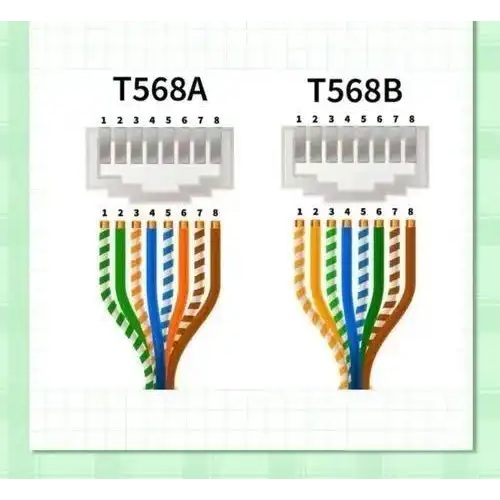
T568A/T568B: Two wiring schemes for RJ45 connectors.
T568A: White-green, Green, White-orange, Blue, White-blue, Orange, White-brown, Brown.
T568B: White-orange, Orange, White-green, Blue, White-blue, Green, White-brown, Brown.
Patch Cables: Pre-terminated cables with RJ45 connectors.
6. Performance Categories (Cat5e vs. Cat6 vs. Cat6a)
| Category | Speed | Bandwidth | Distance | Shielding |
| Cat5e | 1 Gbps | 100 MHz | 100M | UTP |
| Cat6 | 10 Gbps | 250 MHz | 55M/10G, 100M/1G | UTP/STP |
| Cat6a | 10 Gbps | 500 MHz | 100M | STP |
7. Future Trends
Cat8: Emerging for data centers (40 Gbps up to 30m).
Cat9: Under development for higher frequencies.
PoE++: Supports up to 100W power delivery.
Conclusion
Ethernet cable standards evolve with technology, offering faster speeds and higher bandwidth. Choose the right cable based on your network needs:
Home use: Cat5e or Cat6.
Enterprise/data centers: Cat6a or Cat7.
Outdoor/industrial: Armored or outdoor-rated cables.
For more technical details, refer to industry standards like TIA/EIA-568.